New York City
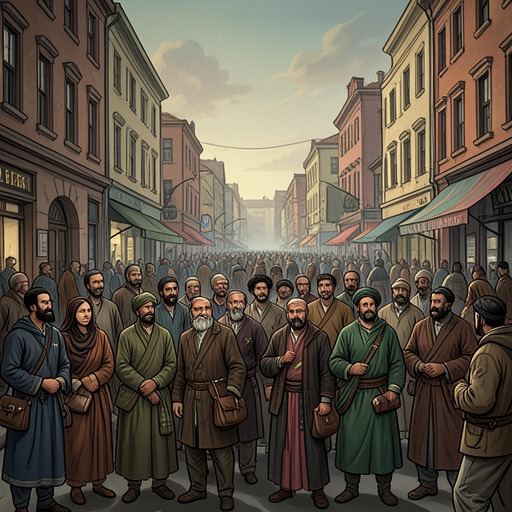
The Sun is Also a StarNew York City gathers the novel’s private choices and public pressures into a landscape of neighborhoods that feel close on a map but socially distinct. For the Kingsleys, it is the destination of Samuel’s acting ambition and the place where that ambition collides with work and family responsibility. For Natasha, the city is both the home she fears losing and the setting of an uncertain future; for her and Daniel, its streets expose differences in background even as they offer a place to walk together.
A City of Distinct Neighborhoods
The city appears not as one uniform metropolis but as a succession of local worlds. In Flushing, news of Charlie Bae’s removal from Harvard circulates through the Korean community, reaching the family amid the disapproval and confusion of his mother. His father insists on the distinction between being kicked out and being required to withdraw. The episode makes the family’s New York setting a social network as well as a physical place: educational status becomes public knowledge, and the family’s response unfolds under the gaze of its community.
Harlem offers a different neighborhood view. After a subway ride of about twenty-five minutes, Natasha and Daniel leave the skyscrapers behind for closely packed stores with bright awnings and streets where almost everyone is Black. Walking along Martin Luther King Boulevard, they approach the family business, Black Hair Care. The change of streetscape makes New York’s internal distances perceptible: a short journey carries the characters into a neighborhood with its own visible rhythms and racial politics.
Brooklyn, too, is presented through sharply observed local detail. Natasha’s section of the borough is a six-block commercial drag lined with Jamaican jerk restaurants, bulletproofed Chinese restaurants and liquor stores, discount clothing shops, beauty salons, delis, and check-cashing businesses. Beer and cigarette posters obscure many shop windows, while similar stores crowd each block and compete for the same real estate. Seeing the area with Daniel makes Natasha newly conscious of its relative poverty after Midtown Manhattan; she is grateful for the dark, then ashamed of that response. The neighborhood is not merely scenery but a view of economic inequality that changes as she imagines how it appears to someone else.
Samuel’s Ambition and the Family’s Settlement
Samuel Kingsley reaches the United States two years before Patricia and Natasha. He goes ahead to establish himself as a Broadway actor, expecting that living alone will let him audition at short notice and make connections in New York City. The separation, originally meant to last one year, extends to two. Natasha, then six, remembers the phone calls: at first her father sounds happy, but after about a year his voice has changed, carrying a different accent and less happiness. Her childhood memory of the city’s pull therefore begins before she lives there, through the changing sound of a parent who has gone ahead to pursue a dream.
When the rest of the family arrives, Samuel’s arrangement must become a household’s means of survival. He takes a security-guard job in a Wall Street building and finds a one-bedroom apartment in Flatbush, Brooklyn. He chooses the graveyard shift so he can audition during the day, but the schedule leaves him tired. Rejection wears down his confidence, and the practical demands of life in the city increasingly press against his hope of acting. New York is both the place that might make the dream possible and the place where the family must pay rent while it remains unrealized.
Work, Hair, and Racial Politics
The Black Hair Care storefront brings the city’s overlapping communities into a single encounter. Natasha recognizes the kind of beauty-supply store her mother regularly visits to buy hair relaxer, and she is aware of the injustice associated with Korean ownership of Black hair-care businesses. The shop’s windows are covered with faded posters depicting Black women with chemically straightened hairstyles. To Natasha, the images imply a narrow standard of which hairstyles look acceptable in professional settings.
That standard reaches into her own family. Her mother has objected that Natasha’s Afro is not professional-looking, while Natasha values both her natural hair and the option of having worn it relaxed. She insists, in effect, on the importance of choosing for herself. In the store’s setting, hair becomes more than a matter of appearance: the competing expectations visible in the posters and the family’s views connect neighborhood commerce to questions of racialized beauty and personal autonomy. Daniel’s nervousness outside the store adds another tension. He tugs at his tie and struggles to introduce his father and brother, leaving Natasha to wonder whether he is anxious about meeting family or about the politics of his parents’ business.
Belonging, Precarity, and Intimacy
For Natasha, New York City is the home she knows, set against a Jamaica she does not feel she knows. At eight years old she had already lived in the United States for years; facing the possibility of leaving, she worries that she would not know anyone in Jamaica or feel that she knew her relatives there as family. Her concerns are also immediate and specific: she is in her senior year, anticipates missing prom and graduation, and has only recently begun an application to Brooklyn College. Her mother has saved for two years to travel to Florida and buy a Social Security card bearing stolen numbers, which Natasha hopes will let her apply for financial aid and perhaps afford SUNY Binghamton or another in-state school. The city is thus the setting of an ordinary teenage future she has only just started to plan, made precarious by the family’s immigration status.
New York also stages the difference between Natasha’s and Daniel’s social positions without making that difference the final word on their relationship. Walking through her Brooklyn neighborhood, Natasha notices curious looks as they hold hands and imagines that being watched might have become normal for them. Daniel says other people’s opinions are peripheral to him and that what matters is Natasha. His response does not erase the neighborhood’s scrutiny or the political questions she raises; it shows that the couple meets those pressures differently. Across Flushing, Harlem, Flatbush, and Manhattan, the city keeps their worlds in view at once: close enough for a subway ride or a shared walk, yet marked by unequal resources, community expectations, and distinct experiences of belonging.